

 Strong by Form Raises €5.8M for Wood Construction Technology


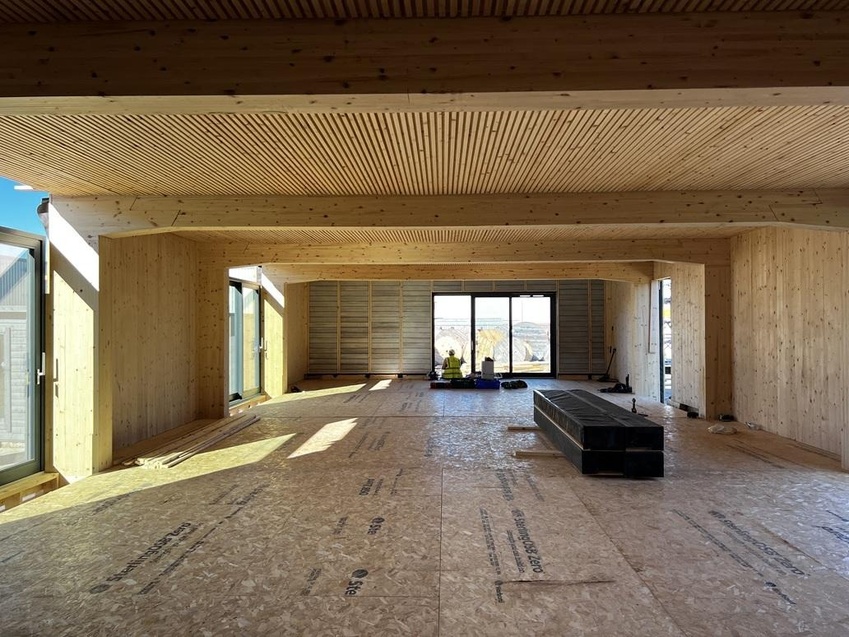
Strong by Form, a deep-tech company developing advanced structural applications for wood, has secured €5.8 million in the initial close of a €10 million Series A financing round.
The investment is being led by boisei investments, a subsidiary of U.S.-based family office and technology venture studio boisei labs. CMPC, the global forestry company that previously led Strong by Form's seed financing, is also participating. Other investors include VX Ventures, Ternel, Savia Ventures, Teampact Ventures, Axel Carbon, FINSA and several undisclosed family offices.
Strong by Form was among 10 teams selected for the Biomimicry Institute's 2022 Ray of Hope Accelerator, with the Ray C. Anderson Foundation serving as the accelerator's key partner.
At the center of the company's technology is Woodflow-core, a structural slab made from wood that is designed to convert lower-grade timber and wood residues into high-performance building components. According to the company, the system can achieve spans of 10 meters or more while delivering strength and cost characteristics comparable to steel and concrete at approximately 80% less weight. It also requires up to 75% fewer trees than other engineered-wood products.
The company is targeting the global concrete slab market, estimated at approximately $120 billion. Strong by Form says its technology could significantly broaden the use of timber in construction, creating opportunities for wood-based structural systems in buildings such as data centers, offices and industrial facilities that traditionally rely heavily on steel and concrete.
The latest funding will support the establishment of manufacturing capacity in Europe, certification of Woodflow-core and its commercial introduction over the next two years. Initial deployments are planned with construction partners in Spain, France, Germany and Switzerland.
Using wood to challenge conventional construction materials
Steel and concrete account for a significant share of the embodied carbon associated with construction. Concrete construction also relies heavily on on-site processes, contributing to an industry that has seen limited productivity improvements over several decades.
Wood offers an alternative because it stores carbon and can be manufactured away from the construction site. However, conventional mass-timber products have faced challenges in simultaneously delivering the structural strength, long spans and competitive economics needed for broader use.
Strong by Form has developed Woodflow-core specifically to address these limitations. Its Woodflow technology applies computational design to position structural wood fibers according to where loads are greatest. The approach is inspired by the way trees naturally allocate additional material to areas that experience greater structural stress.
The resulting slab is designed to weigh substantially less than a comparable concrete structure while using considerably less timber than conventional mass-timber solutions.
Rather than attempting to eliminate concrete and steel throughout an entire building, Strong by Form is concentrating on the slab, which represents one of the building's most substantial structural components. The company's approach is intended to allow construction companies to retain familiar building practices while replacing conventional slabs with a lighter timber alternative. This could facilitate greater use of timber in hybrid construction projects.
The market opportunity is substantial. Global concrete slabs represent an estimated $120 billion market, while cross-laminated timber accounts for less than $1.5 billion. Strong by Form plans to work alongside mass-timber manufacturers rather than compete directly with them, potentially giving those producers access to a much larger market. The company says the approach could also increase manufacturers' margins by as much as 50%.
The new financing will help Strong by Form establish European production capabilities, complete the certification process for Woodflow-core and begin commercial deployments within the next two years.
Andrés Mitnik, CEO and co-founder of Strong by Form, said the company's objective has been to demonstrate that wood can compete directly with traditional construction materials based on performance and economics. He described seeing the company's first 10-meter slab alongside the team responsible for building it as a particularly significant milestone in his career.
George Perry, President and founder of boisei labs, said Strong by Form represents the type of company his organization seeks to support, combining deep scientific research with a major decarbonization opportunity and an economic proposition that does not depend solely on environmental incentives.
Bernardita Araya, Fund Manager at CMPC Ventures, said the firm has backed Strong by Form from its early stages because of its nature-inspired approach to wood engineering. She added that the latest milestone demonstrates the team's progress and provides a foundation for the company's next stage of industrial development and market expansion.
The investment is being led by boisei investments, a subsidiary of U.S.-based family office and technology venture studio boisei labs. CMPC, the global forestry company that previously led Strong by Form's seed financing, is also participating. Other investors include VX Ventures, Ternel, Savia Ventures, Teampact Ventures, Axel Carbon, FINSA and several undisclosed family offices.
Strong by Form was among 10 teams selected for the Biomimicry Institute's 2022 Ray of Hope Accelerator, with the Ray C. Anderson Foundation serving as the accelerator's key partner.
At the center of the company's technology is Woodflow-core, a structural slab made from wood that is designed to convert lower-grade timber and wood residues into high-performance building components. According to the company, the system can achieve spans of 10 meters or more while delivering strength and cost characteristics comparable to steel and concrete at approximately 80% less weight. It also requires up to 75% fewer trees than other engineered-wood products.
The company is targeting the global concrete slab market, estimated at approximately $120 billion. Strong by Form says its technology could significantly broaden the use of timber in construction, creating opportunities for wood-based structural systems in buildings such as data centers, offices and industrial facilities that traditionally rely heavily on steel and concrete.
The latest funding will support the establishment of manufacturing capacity in Europe, certification of Woodflow-core and its commercial introduction over the next two years. Initial deployments are planned with construction partners in Spain, France, Germany and Switzerland.
Using wood to challenge conventional construction materials
Steel and concrete account for a significant share of the embodied carbon associated with construction. Concrete construction also relies heavily on on-site processes, contributing to an industry that has seen limited productivity improvements over several decades.
Wood offers an alternative because it stores carbon and can be manufactured away from the construction site. However, conventional mass-timber products have faced challenges in simultaneously delivering the structural strength, long spans and competitive economics needed for broader use.
Strong by Form has developed Woodflow-core specifically to address these limitations. Its Woodflow technology applies computational design to position structural wood fibers according to where loads are greatest. The approach is inspired by the way trees naturally allocate additional material to areas that experience greater structural stress.
The resulting slab is designed to weigh substantially less than a comparable concrete structure while using considerably less timber than conventional mass-timber solutions.
Rather than attempting to eliminate concrete and steel throughout an entire building, Strong by Form is concentrating on the slab, which represents one of the building's most substantial structural components. The company's approach is intended to allow construction companies to retain familiar building practices while replacing conventional slabs with a lighter timber alternative. This could facilitate greater use of timber in hybrid construction projects.
The market opportunity is substantial. Global concrete slabs represent an estimated $120 billion market, while cross-laminated timber accounts for less than $1.5 billion. Strong by Form plans to work alongside mass-timber manufacturers rather than compete directly with them, potentially giving those producers access to a much larger market. The company says the approach could also increase manufacturers' margins by as much as 50%.
The new financing will help Strong by Form establish European production capabilities, complete the certification process for Woodflow-core and begin commercial deployments within the next two years.
Andrés Mitnik, CEO and co-founder of Strong by Form, said the company's objective has been to demonstrate that wood can compete directly with traditional construction materials based on performance and economics. He described seeing the company's first 10-meter slab alongside the team responsible for building it as a particularly significant milestone in his career.
George Perry, President and founder of boisei labs, said Strong by Form represents the type of company his organization seeks to support, combining deep scientific research with a major decarbonization opportunity and an economic proposition that does not depend solely on environmental incentives.
Bernardita Araya, Fund Manager at CMPC Ventures, said the firm has backed Strong by Form from its early stages because of its nature-inspired approach to wood engineering. She added that the latest milestone demonstrates the team's progress and provides a foundation for the company's next stage of industrial development and market expansion.
 Companies