

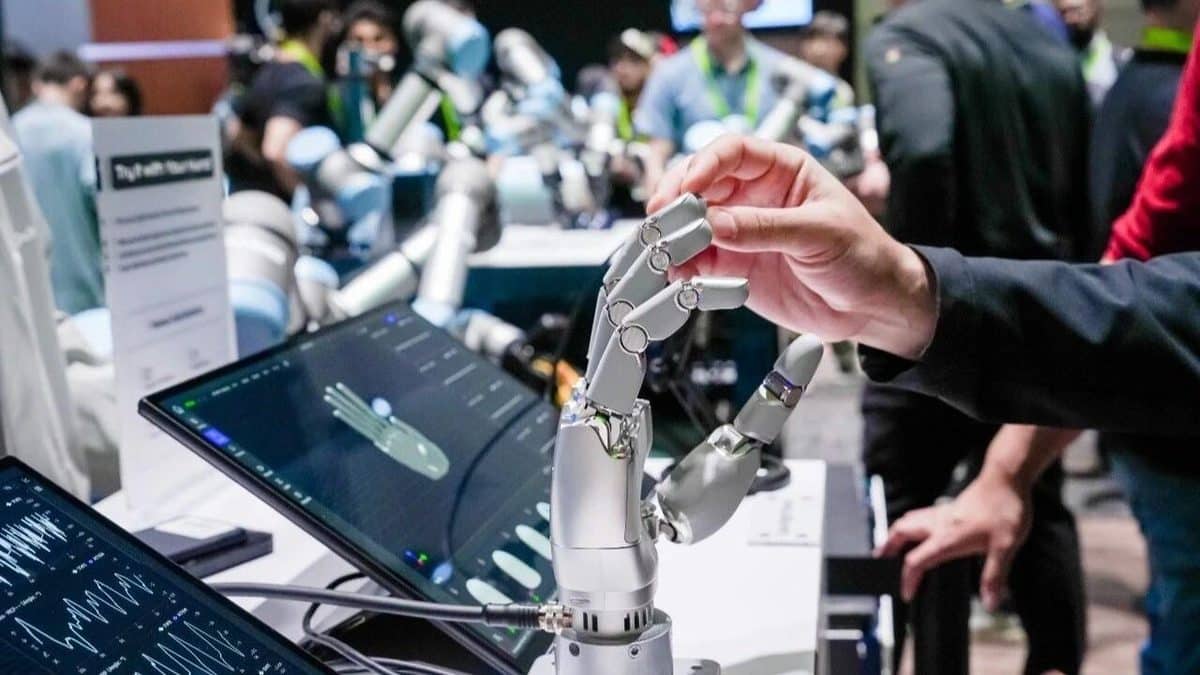
Xynova Prima 1 Robotic Hand Recognised in CES 2027 Innovation Awards
The Xynova Prima 1 robotic hand, a fully direct-drive dexterous robotic hand featuring 22 degrees of freedom, has been named a CES 2027 Innovation Awards® Honoree in the Artificial Intelligence category. The recognition highlights the company’s work on advanced robotic hardware designed to support embodied AI research and the development of more capable physical AI systems.
Developed by Xynova, Prima 1 combines responsive actuation, precise force control and visuo-tactile sensing. The platform is intended to give robotics researchers and AI engineers detailed control over physical interactions, alongside sensory information that can be used to develop and evaluate robotic manipulation models.
Xynova Prima 1 robotic hand focuses on dexterous manipulation
Dexterous manipulation remains one of the significant technical challenges in robotics. Unlike simple pick-and-place operations, handling objects in varied physical conditions requires robots to coordinate finger movements, applied force and sensory feedback continuously.
Changes in an object’s position, surface or contact conditions can require adjustments in how a robotic hand grips and manipulates it. Developing reliable capabilities therefore requires hardware that can respond quickly while capturing detailed information about physical contact.
Xynova says Prima 1 addresses these requirements through a fully direct-drive architecture with 22 degrees of freedom. This configuration is designed to provide responsive finger movements and fine-grained control during complex manipulation tasks.
Direct-drive actuation and force transparency
One of the principal features of Prima 1 is its fully direct-drive actuation system, which the company says delivers millisecond-level response and precise force control.
The architecture also provides low backdrive force and high force transparency. Backdrive force refers to the resistance encountered when an external force moves a robotic mechanism rather than its motors actively driving that movement. Lower resistance can make physical interaction more responsive and help the system provide more natural force feedback.
These characteristics are particularly relevant to robotic manipulation, where the ability to detect and respond to contact forces can influence how successfully a robot handles objects.
Five-finger visuo-tactile sensing
Prima 1 incorporates visuo-tactile sensing across all five fingers to capture detailed information about physical contact.
This sensory feedback is intended to support research involving object handling, contact detection and manipulation strategies. The collected information can also contribute to training and evaluating AI models that need to interact with physical objects.
In addition to its sensing and actuation capabilities, Xynova highlights advanced thermal management and engineering-grade durability. These features are designed to support continuous operation during extended research and development sessions.
Open research platform for embodied AI development
Xynova has designed Prima 1 as an open research platform rather than a hardware system restricted to a single predefined manipulation application.
The robotic hand supports several research approaches, including:
- Imitation learning: Training robotic systems to reproduce actions demonstrated by humans or other systems.
- Teleoperation: Allowing a human operator to control a robot remotely, providing demonstrations and collecting interaction data.
- Sim-to-Real policy transfer: Transferring manipulation strategies developed in simulated environments to physical robotic hardware.
The platform also provides software development kit (SDK) access to control functions and operational data. This allows researchers to develop and evaluate their own manipulation models, control strategies and AI policies using the hardware.
By combining programmable control with detailed sensory feedback, Xynova aims to provide developers with the tools needed to investigate more sophisticated forms of robotic interaction.
CES 2027 Innovation Awards recognises Prima 1
The CES Innovation Awards® programme is organised by the Consumer Technology Association (CTA), which evaluates technology products submitted for consideration.
Entries are assessed by an independent panel of industry experts against three criteria:
- Engineering and functionality.
- Aesthetics and design.
- Uniqueness and innovation.
Prima 1 has received Honoree recognition in the Artificial Intelligence category for the 2027 programme.
Alex Xia, Founder and CEO of Xynova, said the development of dexterous manipulation capabilities would be important in enabling humanoid robots to move beyond basic operations and interact more meaningfully with their surroundings.
He described the CES recognition as an important milestone for the company and an endorsement of its commitment to advancing physical AI.
Xynova to demonstrate robotics technology at CoRL and Web Summit
Alongside the CES recognition, Xynova is using a series of industry events to introduce its technologies to researchers, developers and potential partners.
The company is exhibiting at two events in November 2026:
- Conference on Robot Learning (CoRL): November 9–11, Booth 604.
- Web Summit, Lisbon: November 9–12, Booth E109.
Xynova is inviting researchers, robotics developers and industry partners to visit its exhibition spaces to explore its technologies and discuss potential collaborations.
Prima 1 and Flex 2 to feature at CES 2027
Xynova plans to demonstrate Prima 1 alongside another product, Flex 2, at CES 2027 in Las Vegas.
While Prima 1 uses a fully direct-drive architecture, Flex 2 is a hybrid-drive dexterous robotic hand designed for precision manipulation in real-world applications.
The CES exhibition will take place from January 6–9, 2027, at the Las Vegas Convention Center. Visitors will be able to meet the Xynova team and attend live demonstrations at Booth 12918 in the North Hall.
The two products represent different approaches to robotic hand design, with Xynova positioning them for research and practical manipulation applications.
The recognition of Prima 1 at CES 2027 adds to the growing attention being given to robotic manipulation hardware as developers work to improve the ability of AI-powered machines to interact with the physical world. For Xynova, the next step will be demonstrating how its sensing, actuation and software capabilities can support the development of increasingly capable robotic systems.