

 James Choate-Deeds’ Journey: How Hugo Robotic-Assisted Surgery Transformed Prostate Cancer Treatment


James Choate-Deeds and his wife, Caryn, clasped hands as they waited for the diagnosis, bracing themselves for what was to come.
“Hearing the words ‘you have cancer’ hits you like a punch to the stomach,” James recalled. “Caryn squeezed my hand, and we both broke down. But after that moment passes, your mindset shifts completely to figuring out the next steps.”
At just 57 years old, James was diagnosed with prostate cancer—nearly a decade younger than the typical age of diagnosis. He had always led an active, athletic lifestyle and had no family history of the disease, making the news especially unexpected. Despite the shock, James quickly recognized there were positive factors on his side.
“The cancer was detected early, and it wasn’t aggressive,” he explained. “That gave me time to research my options and choose the right treatment. That’s when I discovered Hugo.”
A new era of robotic-assisted surgery
Robotic-assisted surgery (RAS) represents a modern, minimally invasive approach that has become increasingly common over the past 20 years. For procedures like prostate removal, it is often favored over traditional surgery due to benefits such as increased precision, reduced trauma, and improved recovery outcomes.
The Hugo Robotic-Assisted Surgery system is Medtronic’s first robot designed for soft-tissue procedures and recently received clearance from the U.S. Food and Drug Administration for urologic surgeries, including prostatectomy. When James underwent surgery, the Hugo™ system was still part of clinical research.
“As an architect, I appreciate the value of innovative tools,” James said. “When my surgeon explained that Hugo represented the next generation of surgical technology and believed it was the best option available, that convinced me.”
How the Hugo system operates
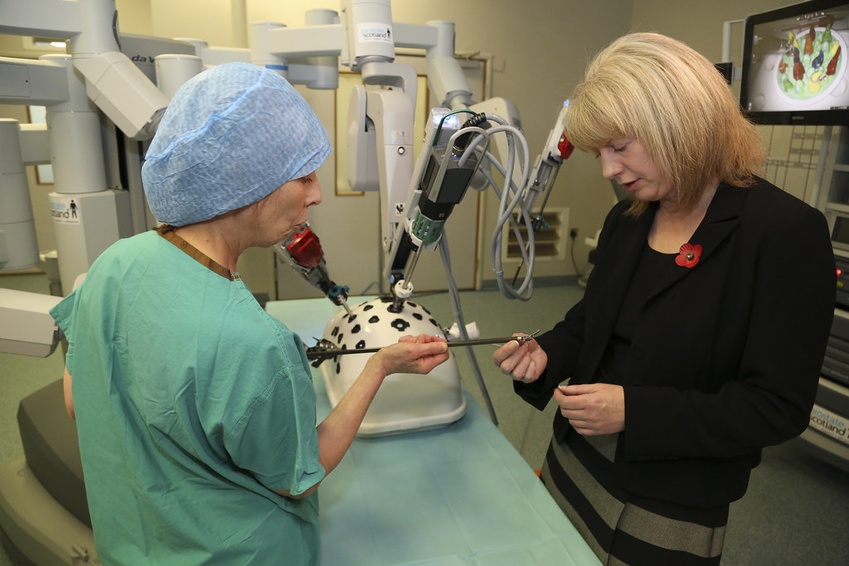
The Hugo™ RAS system uses four independent robotic arms that mirror the movements of a surgeon’s hands. Each arm can hold specialized instruments or a camera and can be positioned flexibly around the operating table to meet the specific needs of each patient.
The surgeon operates from an open console, wearing 3D glasses and viewing the procedure on a large, high-definition display. Using hand and foot controls, the surgeon directs the robotic arms with extreme accuracy.
“While it’s visually guided, it’s far from a video game,” said Dr. James Porter, urologic surgeon and Chief Medical Officer for Robotic Surgical Technologies and Digital Technologies at Medtronic.
“Your hands, feet, and eyes work together. The robotic joints replicate natural human motion but with far greater stability, allowing for exceptional precision—especially during suturing.”
Dr. Porter performed James’ procedure and has completed nearly 6,000 robotic-assisted surgeries over his career. He also spent five years advising Medtronic engineers during the development of the Hugo system and highlights several key advantages:
“Hearing the words ‘you have cancer’ hits you like a punch to the stomach,” James recalled. “Caryn squeezed my hand, and we both broke down. But after that moment passes, your mindset shifts completely to figuring out the next steps.”
At just 57 years old, James was diagnosed with prostate cancer—nearly a decade younger than the typical age of diagnosis. He had always led an active, athletic lifestyle and had no family history of the disease, making the news especially unexpected. Despite the shock, James quickly recognized there were positive factors on his side.
“The cancer was detected early, and it wasn’t aggressive,” he explained. “That gave me time to research my options and choose the right treatment. That’s when I discovered Hugo.”
A new era of robotic-assisted surgery
Robotic-assisted surgery (RAS) represents a modern, minimally invasive approach that has become increasingly common over the past 20 years. For procedures like prostate removal, it is often favored over traditional surgery due to benefits such as increased precision, reduced trauma, and improved recovery outcomes.
The Hugo Robotic-Assisted Surgery system is Medtronic’s first robot designed for soft-tissue procedures and recently received clearance from the U.S. Food and Drug Administration for urologic surgeries, including prostatectomy. When James underwent surgery, the Hugo™ system was still part of clinical research.
“As an architect, I appreciate the value of innovative tools,” James said. “When my surgeon explained that Hugo represented the next generation of surgical technology and believed it was the best option available, that convinced me.”
How the Hugo system operates
The Hugo™ RAS system uses four independent robotic arms that mirror the movements of a surgeon’s hands. Each arm can hold specialized instruments or a camera and can be positioned flexibly around the operating table to meet the specific needs of each patient.
The surgeon operates from an open console, wearing 3D glasses and viewing the procedure on a large, high-definition display. Using hand and foot controls, the surgeon directs the robotic arms with extreme accuracy.
“While it’s visually guided, it’s far from a video game,” said Dr. James Porter, urologic surgeon and Chief Medical Officer for Robotic Surgical Technologies and Digital Technologies at Medtronic.
“Your hands, feet, and eyes work together. The robotic joints replicate natural human motion but with far greater stability, allowing for exceptional precision—especially during suturing.”
Dr. Porter performed James’ procedure and has completed nearly 6,000 robotic-assisted surgeries over his career. He also spent five years advising Medtronic engineers during the development of the Hugo system and highlights several key advantages:
- Enhanced visualization: Three-dimensional imaging improves depth perception during surgery.
- Greater flexibility: Modular arms can be positioned freely, improving access to anatomy and expanding patient eligibility.
- Improved ergonomics and teamwork: Surgeons operate while seated at an open console, reducing strain and improving communication with the surgical team.
“These features are all designed to help surgeons provide the highest level of care,” Dr. Porter said. “At the end of the day, it’s about improving patients’ lives.”
Shaping the future of surgery
Despite advances in technology, nearly 90% of surgeries worldwide are still performed without robotic assistance, and approximately 60% remain open procedures. This limits patient access to the benefits of minimally invasive surgery, such as fewer complications, shorter hospital stays, and faster recovery times.
The Hugo™ RAS system is currently FDA-cleared in the U.S. for urologic procedures, with plans to pursue approvals for additional uses, including general and gynecologic surgery. Internationally, the system is already approved for multiple indications in more than 30 countries.
“The precision offered by robotic-assisted surgery delivers tremendous value to patients,” said Rajit Kamal, Vice President and General Manager of Robotic Surgical Technologies at Medtronic. “Robotics and digital innovation are redefining what’s possible in surgery—moving toward procedures that are more accurate, consistent, and tailored to each individual.”
Dr. Porter believes the next major leap will come from combining robotic systems with advanced software and artificial intelligence.
“In the future, surgeons could access real-time 3D organ models during procedures,” he explained. “AI could provide insights like optimal instrument angles while operating. That level of guidance could be transformative for both surgeons and patients—and it’s exactly what our digital teams are working toward.”
That vision drew Dr. Porter to Medtronic, but for now, he continues caring for patients like James.
Life after surgery
Two and a half years later, James remains as active as ever—hiking, skiing, playing hockey, traveling frequently, and continuing his architectural career.
“I’m rarely sitting still,” he joked. “Thanks to an incredible surgical team and the Hugo system, the surgery and recovery were remarkably smooth. Life feels amazing, and I’m deeply thankful for the technology that helped make that possible.”
Shaping the future of surgery
Despite advances in technology, nearly 90% of surgeries worldwide are still performed without robotic assistance, and approximately 60% remain open procedures. This limits patient access to the benefits of minimally invasive surgery, such as fewer complications, shorter hospital stays, and faster recovery times.
The Hugo™ RAS system is currently FDA-cleared in the U.S. for urologic procedures, with plans to pursue approvals for additional uses, including general and gynecologic surgery. Internationally, the system is already approved for multiple indications in more than 30 countries.
“The precision offered by robotic-assisted surgery delivers tremendous value to patients,” said Rajit Kamal, Vice President and General Manager of Robotic Surgical Technologies at Medtronic. “Robotics and digital innovation are redefining what’s possible in surgery—moving toward procedures that are more accurate, consistent, and tailored to each individual.”
Dr. Porter believes the next major leap will come from combining robotic systems with advanced software and artificial intelligence.
“In the future, surgeons could access real-time 3D organ models during procedures,” he explained. “AI could provide insights like optimal instrument angles while operating. That level of guidance could be transformative for both surgeons and patients—and it’s exactly what our digital teams are working toward.”
That vision drew Dr. Porter to Medtronic, but for now, he continues caring for patients like James.
Life after surgery
Two and a half years later, James remains as active as ever—hiking, skiing, playing hockey, traveling frequently, and continuing his architectural career.
“I’m rarely sitting still,” he joked. “Thanks to an incredible surgical team and the Hugo system, the surgery and recovery were remarkably smooth. Life feels amazing, and I’m deeply thankful for the technology that helped make that possible.”
 Companies