

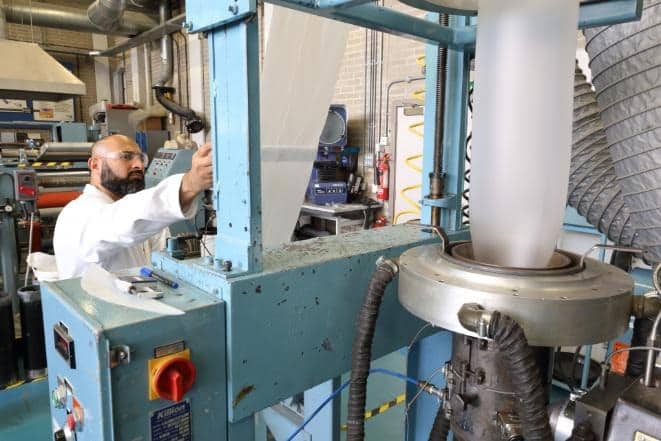
Taiwan-based GENIUS MACHINERY will present its DWX squeeze dryer, an integrated plastic film recycling system, at IPF Japan 2026 from December 1 to 5. The machine combines squeezing and extrusion in a compact configuration designed to reduce material moisture, energy consumption and operational complexity.
The exhibition will take place at Makuhari Messe in Chiba, Japan. GENIUS MACHINERY will share Hall 7, Booth 71814 with its long-term Japanese distributor, Zoryu Gijutsu Co., Ltd. Visitors will be able to examine the DWX system and compare plastic film samples before and after squeezing to assess its dewatering performance and volume reduction.
DWX squeeze dryer combines dewatering and extrusion
GENIUS developed the DWX series specifically for plastic film recycling applications. The system integrates squeezing and extrusion into a single compact unit powered by one motor and one screw, reducing the need for separate processing machines.
The design incorporates the dewatering mechanism used in the company’s established DW Series Squeeze Dryer. GENIUS says more than 55 units of the standalone DW technology have been sold in Japan, where the equipment has been used by local plastic recyclers.
According to the manufacturer, the DW Series has reduced moisture content in processed post-consumer film from approximately 50% to below 1%. The company also reports that pellet rejection rates in existing Japanese operations have fallen from 15–20% to below 1%.
The DWX builds on this dewatering technology by placing the squeezing stage directly before extrusion. Washed plastic film with moisture content above 50% is squeezed to below 1% before being fed into the extruder.
This integrated arrangement is intended to streamline processing through a single heating cycle. By avoiding repeated melting cycles, the system aims to limit thermal degradation of the polymer while reducing unnecessary energy and resource consumption.
Plastic recyclers face rising energy and labour costs
The DWX launch comes as plastic recycling businesses contend with increasing operating pressures. Labour shortages and rising electricity and fuel costs are creating challenges for plant operators seeking to maintain production volumes while controlling expenses.
These pressures are particularly relevant to facilities processing agricultural films, LDPE and HDPE films, and post-consumer flexible packaging. Such operations need to maintain throughput while managing labour requirements and power consumption.
GENIUS argues that equipment selection should therefore consider total cost of ownership rather than focusing exclusively on the initial purchase price. Electricity consumption and staffing costs can have a substantial influence on the long-term economics of a recycling operation.
DWX configuration could reduce electricity consumption
To illustrate the potential savings, GENIUS has cited a recent line-configuration assessment conducted for a Western European polyethylene film recycling group.
The assessment compared a conventional three-machine arrangement with a single DWX-3512-class configuration.
| Parameter | Traditional setup | DWX configuration |
| Number of machines | 3 | 1 |
| Total installed main-motor power | 432 kW | 150 kW |
| Estimated monthly electricity reduction | — | Approximately 107,000 kWh |
The electricity estimate assumes continuous operation for 24 hours per day, 22 days per month, an operating load of 80% and a power factor of 0.9.
Based on this assessment, GENIUS estimates that the DWX series could deliver energy cost savings of up to 65%. The company also says that one or two operators could manage the entire recycling line.
However, these figures are estimates rather than guaranteed outcomes. Actual savings will depend on factors such as local electricity prices, material characteristics, incoming moisture levels and production throughput.
GENIUS highlights established dewatering technology
Peter Tsai, CEO of GENIUS MACHINERY, said Japanese recyclers place particular importance on equipment quality and demonstrable performance.
He said the DWX was developed around the established dewatering mechanism of the DW Series, with the aim of helping film recyclers reduce electricity expenses and simplify staffing without compromising pellet quality.
Tsai also invited visitors to examine the equipment and review the company’s performance and cost estimates at the exhibition.
GENIUS to offer technical consultations at IPF Japan 2026
At Hall 7, Booth 71814, GENIUS MACHINERY and Zoryu Gijutsu Co., Ltd. will have technical specialists available to discuss recycling-line configurations and equipment performance.
Visitors can also request customised total-cost-of-ownership assessments and material testing. These consultations are intended to help recyclers evaluate how the integrated DWX configuration could fit their processing requirements.
Through the DWX demonstration, GENIUS aims to show how combining dewatering and extrusion can simplify plastic film recycling while addressing the industry’s growing focus on energy efficiency, labour requirements and operating costs.