
Boehringer Ingelheim Advances to Sixth Place in 2026 Access to Medicine Index
Boehringer Ingelheim has secured sixth place in the 2026 Access to Medicine Index (ATMI), continuing its upward movement in the global assessment of pharmaceutical companies’ efforts to improve healthcare access in low- and middle-income countries. The company ranked 13th in 2022 and eighth in 2024.
The latest result reflects progress across the company’s access initiatives, including efforts to improve the availability and affordability of medicines, strengthen healthcare systems, develop local capabilities and expand research partnerships. Boehringer Ingelheim performed above the Index average in all three assessment areas, with particularly strong progress in Product Delivery, the category carrying the greatest weighting.
What the 2026 Access to Medicine Index measures
Published every two years, the Access to Medicine Index assesses the efforts of leading pharmaceutical companies to improve access to medicines in low- and middle-income countries. It ranks the 20 companies included in its assessment.
Boehringer Ingelheim’s latest position reflects what the company describes as a broader approach to healthcare access. Alongside expanding access initiatives, its work increasingly involves long-term partnerships, open research collaboration and more systematic measurement of the impact of its programmes.
“Access to healthcare is not achieved through a single intervention. It requires long-term collaboration to strengthen research, healthcare capabilities, and enabling access to treatment in underserved communities, where significant gaps remain. Our progress in the ATMI is important recognition; however, what matters most is translating that progress into better health outcomes for more people,” said Augusto Muench, Head of Sustainability at Boehringer.
Key initiatives behind Boehringer Ingelheim’s progress
The 2026 assessment highlighted several areas in which the company has expanded or developed its work.
Improving access to cardio-renal-metabolic medicines
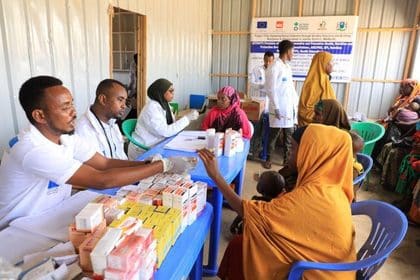
Boehringer Ingelheim has developed more comprehensive access strategies for cardio-renal-metabolic medicines, with the aim of improving their availability and affordability in low- and middle-income countries. One example highlighted in the assessment is its Access to Healthcare initiative in Kenya.
Expanding partnerships and healthcare capacity in Africa
The company has continued to develop long-term partnerships and capacity-building programmes in Sub-Saharan Africa. These include an expanded partnership with the Botswana Vaccine Institute.
Its activities also include support for social entrepreneurs and start-ups working in healthcare. This support is delivered through business incubator and accelerator programmes, as well as impact investments.
CRM Patient Africa combines research and healthcare access
Launched in 2025, CRM Patient Africa is a long-term initiative currently operating in Kenya, Rwanda and Ghana.
The programme brings together several activities: building research capacity, expanding screening and diagnostic services, training healthcare professionals and supporting access to medicines. Its approach combines research and healthcare-system development with efforts to improve patient access to treatment.
Global health programmes continue to expand
Boehringer Ingelheim’s global health initiatives include Stop Rabies and the Angels Initiative.
The Angels Initiative works with ambulance crews, nurses, doctors and hospitals to develop stroke-ready healthcare networks. According to the company, the initiative has reached more than 28 million stroke patients to date.
Open research through opnMe
The company’s opnMe platform supports open science by enabling collaboration with academic researchers and strengthening research and development capacity.
Since the previous Index assessment, research partners from countries covered by the Index have authored or co-authored more than 15 new scientific publications through this collaboration.
Stronger measurement of healthcare outcomes
The assessment also recognised improvements in how Boehringer Ingelheim tracks and reports the outcomes of its access and health-system-strengthening programmes.
More robust measurement is intended to provide a clearer picture of how these initiatives reach patients and contribute to healthcare improvements. It also helps identify which approaches are working and where further changes may be needed.
Health equity remains central to the company’s strategy
The latest progress follows Boehringer Ingelheim’s strategic shift towards health equity in 2023. The company says its approach is intended to extend beyond making medicines available, placing greater emphasis on whether its initiatives produce meaningful and lasting improvements.
“Expanding access is only part of the picture. We also need to understand whether our work is delivering meaningful and lasting change,” said Dr. James Kinniburgh, global MORE HEALTH lead at Boehringer.
He added that stronger measurement provides evidence to assess what works, identify lessons and direct future efforts towards areas where they can make the greatest difference.
Boehringer Ingelheim says it will continue working with global health organisations, local partners and underserved communities to improve the accessibility and affordability of healthcare worldwide. Its sixth-place ranking in the 2026 Access to Medicine Index marks further progress in that effort, although the company has emphasised that improved access must ultimately translate into better health outcomes.