<?xml version="1.0" encoding="UTF-8"?>
<feed xmlns="http://www.w3.org/2005/Atom"  xmlns:media="http://search.yahoo.com/mrss/" xmlns:dc="http://purl.org/dc/elements/1.1/" xmlns:itunes="http://www.itunes.com/dtds/podcast-1.0.dtd" xmlns:geo="http://www.w3.org/2003/01/geo/wgs84_pos#" xmlns:georss="http://www.georss.org/georss" xmlns:photo="http://www.pheed.com/pheed/">
 <title>Daily CSR</title>
 <subtitle><![CDATA[Daily CSR delivers latest news and in-depth coverage about corporate social responsibility, ethics and sustainability]]></subtitle>
 <link rel="alternate" type="text/html" href="https://www.dailycsr.com" />
 <link rel="self" type="text/xml" href="https://www.dailycsr.com/xml/atom.xml" />
 <id>https://www.dailycsr.com/</id>
 <updated>2026-04-27T08:30:01+02:00</updated>
 <generator uri="http://www.wmaker.net">Webzine Maker</generator>
  <icon>https://www.dailycsr.com/favicon.ico</icon>
  <entry>
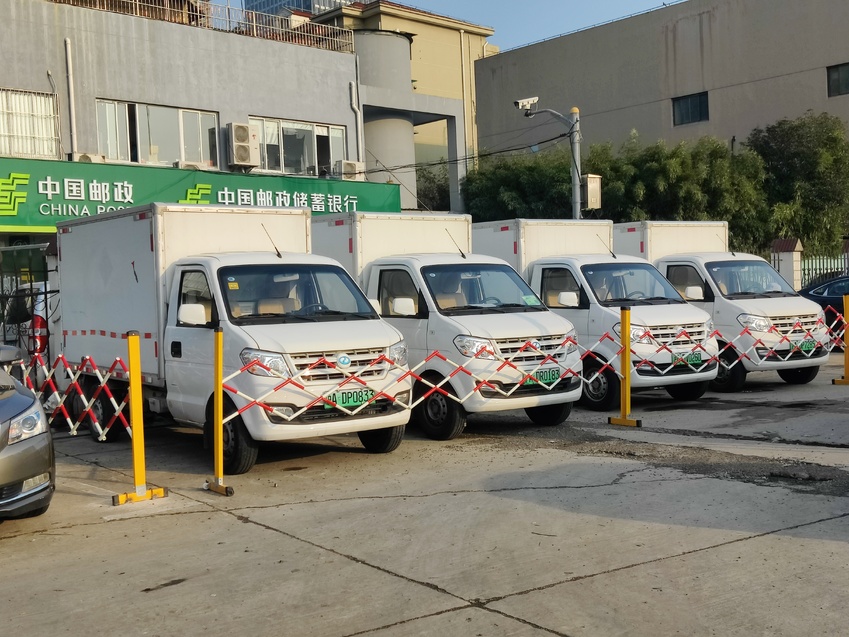
   <title>Neolix Expands RoboVan-as-a-Service for On-Demand Autonomous Delivery</title>
   <updated>2026-03-30T17:53:00+02:00</updated>
   <id>https://www.dailycsr.com/Neolix-Expands-RoboVan-as-a-Service-for-On-Demand-Autonomous-Delivery_a5659.html</id>
   <category term="Companies" />
   <photo:imgsrc>https://www.dailycsr.com/photo/art/imagette/95723544-66864214.jpg</photo:imgsrc>
   <published>2026-03-30T17:51:00+02:00</published>
   <author><name>Debashish Mukherjee</name></author>
   <content type="html">
    <![CDATA[
     <div style="position:relative; text-align : center; padding-bottom: 1em;">
      <img src="https://www.dailycsr.com/photo/art/default/95723544-66864214.jpg?v=1774886028" alt="Neolix Expands RoboVan-as-a-Service for On-Demand Autonomous Delivery" title="Neolix Expands RoboVan-as-a-Service for On-Demand Autonomous Delivery" />
     </div>
     <div>
      <p style="text-align:justify;text-justify:inter-ideograph">Neolix, an international company specializing in autonomous logistics, has announced new developments in its RoboVan-as-a-Service (RaaS) offering, highlighting significant progress toward bringing on-demand autonomous delivery into mainstream use.<o:p></o:p> <br />    <p style="text-align:justify;text-justify:inter-ideograph">The company reports that its delivery platform has processed more than 1.5 million orders and logged over 40 million kilometers of self-driving operations, following rapid expansion across several Chinese cities. In Qingdao—where the service was first scaled—Neolix now operates one of the city’s largest autonomous delivery fleets, with daily orders surpassing 6,500 at peak times.<o:p></o:p> <br />    <p style="text-align:justify;text-justify:inter-ideograph">This achievement signals a shift in how autonomous delivery systems are designed and deployed. Instead of relying on fixed routes or requiring customers to purchase hardware, the RaaS model provides a flexible, network-driven service. Through a mobile app, users can summon an autonomous vehicle in real time for point-to-point deliveries, much like booking a ride through a ride-hailing platform.<o:p></o:p> <br />    <p style="text-align:justify;text-justify:inter-ideograph">Encouraged by these results, Neolix is moving into the next stage of growth. The company aims to roll out its RaaS service in 50 cities across China within the year, while also testing the model internationally in the United Arab Emirates, South Korea, Singapore, and Portugal. These pilot programs will help refine the service for different urban conditions and regulatory environments, supporting future global expansion.<o:p></o:p> <br />    <p style="text-align:justify;text-justify:inter-ideograph">The concept was first introduced in Qingdao in collaboration with Didi Freight in mid-2025. It was designed to address the fragmented and high-frequency delivery demands of small and medium-sized businesses. By offering flexible routing and pay-per-use pricing, the model makes autonomous delivery more accessible and can reduce costs by around 50% compared to traditional methods, while also enhancing reliability.<o:p></o:p> <br />    <p style="text-align:justify;text-justify:inter-ideograph">Neolix’s approach focuses on a large but often overlooked segment of the urban logistics market. In China, city-based distribution represents a multi-trillion-renminbi industry, yet much of the demand comes from small retailers, wholesalers, and local service providers with irregular and time-sensitive needs. The RaaS model caters to these requirements through a shared, on-demand network that supports a wide range of use cases—from restocking retail outlets and delivering fresh produce to handling pharmaceutical and industrial shipments—operating continuously to sustain urban supply chains.<o:p></o:p> <br />    <p style="text-align:justify;text-justify:inter-ideograph">At the core of this system is a combination of advanced vehicle autonomy and cloud-based coordination. Neolix has deployed Level 4 autonomous driving technology at scale, enabling vehicles to navigate complex city environments without relying on high-definition maps, which accelerates deployment in new regions. Meanwhile, a centralized control system connects all vehicles into a single network, enabling real-time dispatching and route optimization across large volumes of orders. As the fleet grows and expands geographically, this networked model enhances efficiency, reduces response times, and lowers incremental costs, strengthening scalability.<o:p></o:p> <br />    <p style="text-align:justify;text-justify:inter-ideograph">The company emphasized that as autonomous technology evolves, the industry is shifting its focus from standalone vehicles to integrated service ecosystems. Neolix aims to position autonomous delivery as a shared infrastructure that improves urban logistics efficiency and supports the digital transformation of supply chains.<o:p></o:p> <br />    <p style="text-align:justify;text-justify:inter-ideograph">With ongoing expansion and increasing operational capabilities, Neolix expects its RaaS solution to play a key role in the future of city logistics, offering a more adaptable and scalable alternative to conventional delivery systems.<o:p></o:p> <br />  
     </div>
     <br style="clear:both;"/>
    ]]>
   </content>
   <link rel="alternate" href="https://www.dailycsr.com/Neolix-Expands-RoboVan-as-a-Service-for-On-Demand-Autonomous-Delivery_a5659.html" />
  </entry>
  <entry>
   <title>Electric Three-Wheeler Market Growth Driven by EV Policies and E-Commerce Demand</title>
   <updated>2026-03-25T14:13:00+01:00</updated>
   <id>https://www.dailycsr.com/Electric-Three-Wheeler-Market-Growth-Driven-by-EV-Policies-and-E-Commerce-Demand_a5643.html</id>
   <category term="Companies" />
   <photo:imgsrc>https://www.dailycsr.com/photo/art/imagette/95604560-66808043.jpg</photo:imgsrc>
   <published>2026-03-25T14:10:00+01:00</published>
   <author><name>Debashish Mukherjee</name></author>
   <content type="html">
    <![CDATA[
     <div style="position:relative; text-align : center; padding-bottom: 1em;">
      <img src="https://www.dailycsr.com/photo/art/default/95604560-66808043.jpg?v=1774444424" alt="Electric Three-Wheeler Market Growth Driven by EV Policies and E-Commerce Demand" title="Electric Three-Wheeler Market Growth Driven by EV Policies and E-Commerce Demand" />
     </div>
     <div>
      <div style="text-align: justify;">According to a recent analysis by Mordor Intelligence, the global electric three-wheeler market was estimated at USD 3.65 billion in 2025 and is expected to rise to USD 4.2 billion in 2026, eventually reaching USD 8.47 billion by 2031, reflecting a compound annual growth rate (CAGR) of 15.08%. This expansion is largely supported by favorable government initiatives such as India’s PM E-DRIVE and the proposed FAME-III, along with incentives introduced in the United States and Europe that are improving the affordability of electric fleets. <br />   <br />  Additionally, falling lithium-ion battery costs—down by 12% in 2024—are encouraging a transition away from lead-acid batteries. Infrastructure improvements are also enhancing operational efficiency; for instance, Battery Smart achieved 50 million battery swaps across 1,400 stations by October 2025, helping reduce vehicle downtime. <br />   <br />  <strong>Electric Three-Wheeler Trends and Drivers</strong> <br />  <strong>E-commerce Growth Transforming Last-Mile Delivery</strong> <br />  The surge in online shopping is increasing demand for efficient last-mile delivery solutions, prompting logistics providers to shift from two-wheelers to higher-capacity three-wheelers. These vehicles offer lower operating costs, making them particularly appealing in emerging economies where drivers directly benefit from savings. At the same time, global retailers are adopting electric mobility solutions for urban logistics, while battery swapping technology is minimizing downtime and maximizing vehicle utilization. <br />   <br />  <strong>Extended Incentive Programs Supporting Expansion</strong> <br />  Government incentives continue to play a crucial role in lowering initial purchase costs and accelerating adoption. In India and other key markets, subsidy frameworks are being introduced with gradual adjustments to maintain stable demand. Comparable policy backing in the US and Europe is encouraging manufacturers to scale production. This consistency is also improving access to financing, enabling more balanced and sustained growth across regions. <br />   <br />  <strong>Regional Market Share</strong> <br />  The Asia-Pacific region remains the dominant force in the electric three-wheeler market, driven by strong demand in countries such as India and increasing manufacturing activity in China and Southeast Asia. Continued government support and infrastructure development further strengthen the region’s leadership. <br />   <br />  In contrast, the Middle East and Africa are emerging as the fastest-growing regions, supported by sustainability initiatives and the use of electric vehicles as income-generating assets. Meanwhile, adoption in Europe and North America is progressing more slowly due to regulatory complexities and cost-related challenges, although urban mobility programs are fostering steady growth. <br />   <br />  <strong>Market Segmentation</strong> <br />  <strong>By End Use</strong></div>    <ul>  	<li style="text-align: justify;">Passenger Carrier</li>  	<li style="text-align: justify;">Goods Carrier</li>  </ul>    <div style="text-align: justify;"><strong>By Battery Type</strong></div>    <ul>  	<li style="text-align: justify;">Lithium-ion</li>  	<li style="text-align: justify;">Lead-acid</li>  </ul>    <div style="text-align: justify;"><strong>By Power Output (kW)</strong></div>    <ul>  	<li style="text-align: justify;">Below 2 kW</li>  	<li style="text-align: justify;">2–4 kW</li>  	<li style="text-align: justify;">4–6 kW</li>  	<li style="text-align: justify;">Above 6 kW</li>  </ul>    <div style="text-align: justify;"><strong>By Charging Model</strong></div>    <ul>  	<li style="text-align: justify;">Fixed (plug-in) charging</li>  	<li style="text-align: justify;">Battery swapping</li>  </ul>    <div style="text-align: justify;">Phani Kumar, Senior Research Manager at Mordor Intelligence, notes that the electric three-wheeler market is experiencing consistent demand, largely influenced by policy support and the needs of last-mile delivery. He adds that the firm’s structured approach—combining primary research with verified data—provides a clear and reliable perspective for decision-makers compared to less cohesive sources.</div>  
     </div>
     <br style="clear:both;"/>
    ]]>
   </content>
   <link rel="alternate" href="https://www.dailycsr.com/Electric-Three-Wheeler-Market-Growth-Driven-by-EV-Policies-and-E-Commerce-Demand_a5643.html" />
  </entry>
  <entry>
   <title>FedEx Launches First Electric Delivery Fleet in Taiwan with FUSO</title>
   <updated>2025-08-12T13:09:00+02:00</updated>
   <id>https://www.dailycsr.com/FedEx-Launches-First-Electric-Delivery-Fleet-in-Taiwan-with-FUSO_a5020.html</id>
   <category term="Companies" />
   <photo:imgsrc>https://www.dailycsr.com/photo/art/imagette/90452445-63782201.jpg</photo:imgsrc>
   <published>2025-08-12T13:06:00+02:00</published>
   <author><name>Debashish Mukherjee</name></author>
   <content type="html">
    <![CDATA[
     <div style="position:relative; text-align : center; padding-bottom: 1em;">
      <img src="https://www.dailycsr.com/photo/art/default/90452445-63782201.jpg?v=1754996965" alt="FedEx Launches First Electric Delivery Fleet in Taiwan with FUSO" title="FedEx Launches First Electric Delivery Fleet in Taiwan with FUSO" />
     </div>
     <div>
      <div style="text-align: justify;">FedEx Express, a subsidiary of FedEx Corporation and one of the world’s leading express transportation providers, has partnered with FUSO to add 12 fully electric delivery trucks to its ground fleet in Taiwan. This milestone makes FedEx the first international logistics company in the country to integrate electric vehicles into its delivery network. The initial rollout of six vehicles is already in service, offering features such as extended driving range, regenerative braking, and strong torque — well-suited for navigating urban delivery routes. <br />   <br />  According to FUSO’s assessments, the electric trucks deliver significant energy cost savings compared to conventional diesel models. Purpose-built for city deliveries in Taiwan, the vehicles feature enhanced maneuverability and can travel up to 200 kilometers on a single charge when equipped with three battery packs. Regenerative braking reduces charging downtime, while their responsive acceleration and start-up capabilities help them adapt easily to local traffic conditions, improving delivery efficiency. <br />   <br />  “Fleet electrification plays a vital role in our journey toward achieving carbon-neutral operations globally by 2040,” said Paul Sousa, Managing Director of FedEx Taiwan. “Introducing electric delivery trucks reflects our commitment to sustainability, driving both cost efficiency and operational effectiveness while contributing to the long-term growth of Taiwan’s logistics sector.” <br />   <br />  Jung Woo Park, CEO of Daimler Trucks Asia Taiwan, added, “We are proud to supply FedEx with the all-electric FUSO eCanter. This globally tested truck combines high performance with efficiency, meeting the complex requirements of Taiwan’s urban delivery environment. Our goal is to help businesses achieve smarter, greener logistics through proven technology and robust after-sales support.” <br />   <br />  This move follows FedEx’s introduction of five Rapide 3 electric tricycles in Taiwan in December 2023. As part of its broader strategy, the company will continue to monitor the new fleet’s performance and gradually expand the electrification of its pickup and delivery vehicles. Through these efforts, FedEx aims to strengthen its operations in Taiwan, advance sustainable logistics practices, and help drive the industry toward a low-carbon future — in alignment with its global target of carbon neutrality by 2040.</div>  
     </div>
     <br style="clear:both;"/>
    ]]>
   </content>
   <link rel="alternate" href="https://www.dailycsr.com/FedEx-Launches-First-Electric-Delivery-Fleet-in-Taiwan-with-FUSO_a5020.html" />
  </entry>
</feed>