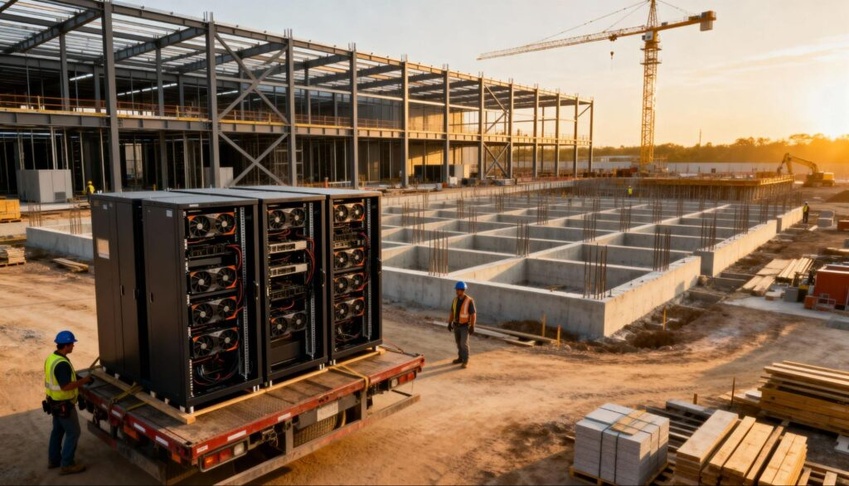
Artificial intelligence–driven “factory of the future” technologies are transforming manufacturing economics and could deliver productivity improvements of as much as 60%. This evolution is redefining global competitiveness, where success increasingly depends on how efficiently companies redesign and implement advanced production systems. For the first time, investing in next-generation manufacturing capabilities in high-cost countries may prove more competitive than relocating production overseas, even when lower-cost nations adopt similar technologies. At the same time, failing to modernize could place nearly $1.03 trillion in manufacturing value in Western Europe and approximately $440 billion in the United States at risk of moving elsewhere.
A recent study by Boston Consulting Group (BCG) and the BCG Institute, titled *How the Factory of the Future Is Reshaping the Economics of Manufacturing*, draws on a global survey of 1,000 manufacturers along with proprietary quantitative research to explore how AI, automation, and digital technologies are reshaping large-scale production.
According to Daniel Kuepper, Managing Director and Senior Partner at BCG, as well as coauthor of the report, manufacturers are moving into a period where competitiveness is no longer determined primarily by fixed cost comparisons. Instead, the ability to comprehensively redesign production operations has become the defining factor. He noted that advanced factories are changing both the way companies generate value and the strategic decisions surrounding production locations.
Addressing Geopolitical and Supply Chain Challenges
The factory of the future uses AI-powered systems to redesign production holistically, enabling simultaneous improvements in areas such as energy efficiency, material usage, output quality, and production throughput. Decisions about manufacturing footprints are therefore becoming less dependent on labor cost differences and logistics networks, and more focused on how successfully facilities can be converted into highly productive smart factories. As geopolitical instability and supply chain disruptions continue to grow, these capabilities are increasingly important for companies seeking greater resilience by manufacturing closer to their customer markets.
Uneven Benefits Across Industries and Regions
The advantages of factory-of-the-future technologies are not distributed equally across all industries or geographies. Factors such as labor expenses, energy prices, material costs, automation potential, and logistics intensity all influence outcomes. High-cost regions stand to benefit significantly from automating labor-heavy processes, reducing energy consumption, improving production yields, and increasing throughput, thereby narrowing the competitive gap with lower-cost countries. Industries with substantial logistics expenses, including food and beverage manufacturing, gain additional advantages from operating closer to end consumers.
The availability of skilled talent and robust digital infrastructure also plays a critical role in successful adoption. In the BCG Institute survey, 87% of participants stated that access to skilled workers is becoming increasingly important for sustaining advanced manufacturing initiatives, while 69% highlighted the importance of digital infrastructure readiness.
A More Adaptive Manufacturing Environment
Collectively, these developments are creating a more dynamic and variable global manufacturing environment, where competitive strength depends on aligning industry characteristics, regional capabilities, and the successful deployment of advanced technologies. For business leaders, this requires a new approach to production strategy—one that combines technology investment with manufacturing footprint decisions and focuses on redesigning production systems to maximize value creation.
Kuepper emphasized that organizations capable of integrating manufacturing footprint strategies with advanced production technologies will be in the strongest position to compete successfully in the years ahead.
A recent study by Boston Consulting Group (BCG) and the BCG Institute, titled *How the Factory of the Future Is Reshaping the Economics of Manufacturing*, draws on a global survey of 1,000 manufacturers along with proprietary quantitative research to explore how AI, automation, and digital technologies are reshaping large-scale production.
According to Daniel Kuepper, Managing Director and Senior Partner at BCG, as well as coauthor of the report, manufacturers are moving into a period where competitiveness is no longer determined primarily by fixed cost comparisons. Instead, the ability to comprehensively redesign production operations has become the defining factor. He noted that advanced factories are changing both the way companies generate value and the strategic decisions surrounding production locations.
Addressing Geopolitical and Supply Chain Challenges
The factory of the future uses AI-powered systems to redesign production holistically, enabling simultaneous improvements in areas such as energy efficiency, material usage, output quality, and production throughput. Decisions about manufacturing footprints are therefore becoming less dependent on labor cost differences and logistics networks, and more focused on how successfully facilities can be converted into highly productive smart factories. As geopolitical instability and supply chain disruptions continue to grow, these capabilities are increasingly important for companies seeking greater resilience by manufacturing closer to their customer markets.
Uneven Benefits Across Industries and Regions
The advantages of factory-of-the-future technologies are not distributed equally across all industries or geographies. Factors such as labor expenses, energy prices, material costs, automation potential, and logistics intensity all influence outcomes. High-cost regions stand to benefit significantly from automating labor-heavy processes, reducing energy consumption, improving production yields, and increasing throughput, thereby narrowing the competitive gap with lower-cost countries. Industries with substantial logistics expenses, including food and beverage manufacturing, gain additional advantages from operating closer to end consumers.
The availability of skilled talent and robust digital infrastructure also plays a critical role in successful adoption. In the BCG Institute survey, 87% of participants stated that access to skilled workers is becoming increasingly important for sustaining advanced manufacturing initiatives, while 69% highlighted the importance of digital infrastructure readiness.
A More Adaptive Manufacturing Environment
Collectively, these developments are creating a more dynamic and variable global manufacturing environment, where competitive strength depends on aligning industry characteristics, regional capabilities, and the successful deployment of advanced technologies. For business leaders, this requires a new approach to production strategy—one that combines technology investment with manufacturing footprint decisions and focuses on redesigning production systems to maximize value creation.
Kuepper emphasized that organizations capable of integrating manufacturing footprint strategies with advanced production technologies will be in the strongest position to compete successfully in the years ahead.
]]>